You may remember her as the fearless, no-nonsense Sgt. Debbie Callahan from Police Academy, or perhaps as the terrifying villain who appeared in Rob Zombie’s unforgettable horror films.
But Leslie Easterbrook’s story goes far beyond her most famous Hollywood roles. Her career is a remarkable journey of reinvention, determination, and refusing to be defined by other people’s expectations.
From her beginnings in small-town Nebraska to becoming a familiar face on television and the big screen, Easterbrook broke stereotypes and challenged traditional ideas about the kinds of women Hollywood could portray. She became known for playing strong, confident, and sometimes intimidating characters, but her life away from the cameras reveals an equally fascinating story.
So, what happened to the actress who made Sgt. Callahan an unforgettable character, and where is Leslie Easterbrook today?

Adopted When She Was Just Nine Months Old
Leslie Easterbrook’s career is a testament to versatility, resilience, and an unmistakable presence both on and off the screen.
Although millions of viewers recognise her as the formidable yet hilarious Sgt. Debbie Callahan from Police Academy, her journey through the entertainment industry stretches across decades and includes far more than that iconic character.
Born in Nebraska, Leslie was adopted when she was just nine months old. Growing up in the American Midwest helped shape her practical, grounded outlook on life.
Her adoptive parents played an important role in nurturing her interests. Her father was a music professor, while her mother worked as an English teacher. Both parents loved singing, meaning music was a constant part of the household.
As their only child, Leslie grew up surrounded by music and was encouraged to explore her own vocal abilities from an early age.
Her mother once spoke about her daughter’s musical development in an interview with the Omaha World-Herald in 1977.
“It was natural for us to share our love of music with Leslie. We thought she had a sweet voice, and of course, we encouraged her to join vocal groups, but it wasn’t until she went to college that we discovered what a remarkable voice she really has,” her mother explained.
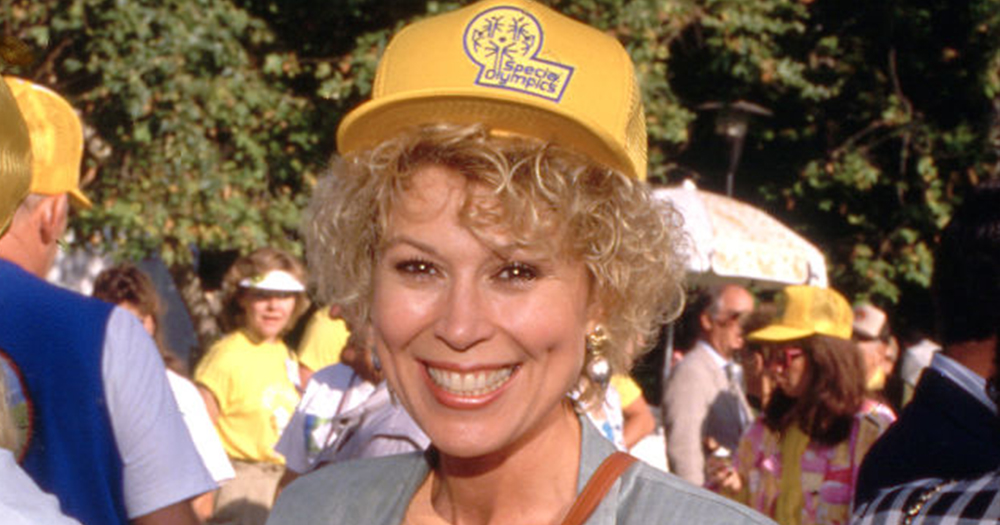
Leslie Easterbrook, June 1989. Photo by Ralph Dominguez/MediaPunch via Getty Images.
As a young woman, Easterbrook dreamed of becoming an opera singer. After graduating from Kearney High School and later attending Stephens College, she appeared to be heading towards a relatively conventional future.
However, her ambitions eventually took a different direction, and Hollywood would soon provide an opportunity that changed her life.
Her first major breakthrough arrived in 1980, when she landed the role of Rhonda Lee on the popular ABC television sitcom Laverne & Shirley.
As the series moved its setting from Milwaukee to California, Easterbrook’s character, a glamorous and quick-witted neighbour, became one of the memorable additions during the show’s later seasons.
Getting the part, however, was not as straightforward as she had initially expected.
Easterbrook later recalled how a Screen Actors Guild strike complicated the process, forcing her to audition repeatedly for a role she believed she had already secured.
“It was really an amazing experience that I finally got to be a part of the show, playing the Rhonda character. Just as I got the part, there was a SAG strike. Then when the strike was over, I got a call telling me I needed to audition again for the part I thought I had already gotten. It wasn’t until six auditions later that I finally got the part and was able to start working,” Leslie once shared.
Although Laverne & Shirley gave her valuable exposure, it was another television and film opportunity that would eventually make her a household name.
Her portrayal of Sgt. Debbie Callahan in Police Academy became the defining role of her career.
Initially, Easterbrook was uncertain about playing such a dominant, sexually confident character. It was a departure from the types of roles she had previously been offered, and she wondered whether she could convincingly portray someone so physically imposing and intimidating.
But she embraced the challenge.
Her commanding screen presence, excellent comedic timing, and fearless attitude helped transform Sgt. Callahan into one of the franchise’s most recognisable characters. The tough police academy instructor quickly became a fan favourite.
Looking back, Easterbrook once explained just how far the character was from her own personality.
“The funny thing is, that’s not me at all. I’d never played tough. I’d played all kinds of things, but I’d never played someone who’s intimidating or someone that was aggressive sexually. I was of a size that I never played the girl who got the guy. I wondered how I could do it. But I did. I went for the audition and I scared the producer and the director and then they backed up in their chairs and I went ‘Oh no, now I really blew it. I scared them.’ So I left the audition upset. I didn’t get to read the script until I got the part. I thought it was outrageous and so funny,” Leslie once said.
What initially felt like an intimidating audition ultimately became one of the most important turning points in her professional life.
How Leslie Easterbrook Prepared to Play Sgt. Callahan
Behind the confident and physically imposing character audiences saw on screen was an actress who took her preparation seriously.
Throughout her Hollywood career, Easterbrook remained committed to maintaining her physical fitness, even though she never hid her appreciation for good food.
She was an enthusiastic athlete who participated in volleyball, developed considerable skills as an equestrian, and maintained a strong passion for running.
Her exercise routine was particularly demanding. Twice a week, she would run approximately 10 miles per session, helping her maintain the fitness and stamina required for her work.
She also attended dance classes and regularly trained at the gym.
However, preparing for Police Academy required something extra.
To bring greater authenticity to Sgt. Callahan’s fearless personality, Easterbrook took intensive karate and martial arts classes. The training helped her develop the physical confidence needed to portray a character who could command attention and hold her own in challenging situations.
There is also an interesting detail about her character’s name. The name “Callahan” is said to be a reference to Clint Eastwood’s famous Dirty Harry character.
Despite the enormous success of Police Academy, the film franchise represented only one chapter of Easterbrook’s extensive career.
Over the years, she accumulated more than 300 television appearances, making guest appearances in popular productions such as Murder, She Wrote, Baywatch, Matlock, and The Dukes of Hazzard.
She also appeared in films, including Private Resort, before exploring a very different side of the entertainment industry during the 2000s.
That transition eventually brought her into the horror genre, where she appeared in films such as Rob Zombie’s The Devil’s Rejects.
For someone who had become famous for comedy, action, and television entertainment, horror offered an entirely new creative challenge.
Easterbrook once explained why the genre fascinated her, particularly the contrast between the disturbing material on screen and the cheerful personalities of the fans she encountered.
“The horror genre intrigues me in many ways, but I am always amazed by the stressful nature of the entertainment. Much of it is grizzly and grinding, but when I meet the fans, they are the most cheerful and delightful people in the world. I meet their children, and their parents. They are good, law-abiding, regular, delightful people. My favorite theory is that they have found a venue to exorcise their demons — and are probably the healthiest folks around,” Leslie said.
Her Role Alongside Johnny Depp in Private Resort
When people discuss Private Resort (1985), one name usually dominates the conversation: Johnny Depp.
The film is particularly remembered for being Depp’s first leading role in a theatrical feature film, with Rob Morrow appearing alongside him.
A classic example of an outrageous 1980s teen sex comedy, Private Resort relied heavily on bikinis, revealing outfits, bare skin, and exaggerated situations to deliver its humour.
But viewers familiar with the film often remember another performer who helped make the story entertaining: Leslie Easterbrook.
She played Bobbie Sue, a seductive and sharp-witted woman who becomes caught up in the chaotic weekend adventures of Jack, played by Depp, and Ben, portrayed by Morrow, at a luxurious beachside resort.
Bobbie Sue was central to one of the film’s major subplots, using her charm, confidence, and cleverness to create a series of unpredictable and comedic situations.
What made Easterbrook’s performance particularly memorable was her ability to combine seductive appeal with impeccable comedic timing.
She brought a mischievous energy to the character, helping elevate the film’s humour while once again demonstrating her ability to portray confident, playful, and unpredictable women.
Although Private Resort never became a major cinematic classic or one of the defining highlights of Johnny Depp’s career, it delivered precisely what audiences expected from an 1980s comedy: outrageous behaviour, ridiculous situations, plenty of troublemaking, and just the right amount of mischief.
For Easterbrook, the production also came with an unexpected behind-the-scenes controversy.
Chaos Behind the Scenes and at the Super Bowl
During the filming of Private Resort, Easterbrook reportedly established clear boundaries about how much she was willing to reveal on screen.
She agreed to expose only her backside, and the condition was included in her contract.
However, producers allegedly persuaded her to wear a sheer negligee. Under the bright studio lights, the outfit reportedly left considerably less to the imagination than she had originally intended.
The film also became the subject of an amusing story involving its two young leading men.
According to reports, Depp and Morrow were so embarrassed by Private Resort that they made a pact to track down and destroy every existing copy of the movie.
Clearly, they were unsuccessful.
Decades later, the film remains available, and Easterbrook’s performance continues to be one of the aspects frequently discussed by people revisiting the production.
But acting was far from her only talent.
Thanks to the musical upbringing encouraged by her adoptive parents, Easterbrook had developed a powerful singing voice that eventually opened another unexpected door in her career.
During the early 1980s, she performed the American national anthem, The Star-Spangled Banner, at several games involving the Los Angeles Dodgers and the California Angels.
Her biggest musical opportunity came in 1983, when she was selected to sing the national anthem at Super Bowl XVII.
It was undoubtedly one of the proudest moments of her life, but getting to the Rose Bowl stadium in Pasadena turned into an adventure filled with unexpected complications.
Her journey towards the performance began relatively modestly.
Easterbrook had been singing at Angels games in exchange for free tickets when her vocal talent attracted the attention of the Los Angeles Rams’ Head of Entertainment.
Word of her performances eventually spread, and she was soon being considered for the prestigious Super Bowl assignment.
However, things did not go smoothly from the beginning.
An unfortunate car accident caused her to miss the game at which NFL commissioner Pete Rozelle had planned to hear her sing. Rather than giving up on the opportunity, Easterbrook sent him a recording of her performance.
Eventually, she secured the job.
But the challenges were far from over.
On the day of the Super Bowl, her limousine driver got lost, leaving her struggling to reach the stadium on time. When she finally arrived, security personnel initially refused to let her enter.
With time running out, Easterbrook found herself running across the Rose Bowl parking lot in high heels while carrying her dress.
By the time she finally made it inside, she had barely caught her breath before it was time to perform.
Despite the chaotic journey, the actual performance went beautifully.
As she prepared to sing, Easterbrook joked with members of the honour guard, helping ease the tension before stepping forward.
From that point, everything went according to plan. She delivered the national anthem successfully, although she later recalled that some players even patted her on the back as though she were one of their teammates.
It was an extraordinary experience filled with missed connections, unexpected obstacles, and last-minute panic. Yet, somehow, everything came together when it mattered most.
The Accident on the Set of Police Academy That Changed Everything
Away from Hollywood, Easterbrook also developed a strong interest in firearm safety and education.
She became an advocate for responsible gun handling and created instructional videos aimed at helping beginners understand firearms and how to use them safely.
Her interest in learning more about firearms began in the early 1990s, following an accident during the filming of a Police Academy video.
During the shoot, she had been asked to fire a starting pistol to signal the beginning of a foot race.
To capture the best possible camera angle, the camera operator instructed her to hold the pistol close to her face.
What she did not realise was that she needed proper hearing protection.
When she fired the weapon, the extremely loud blast caused serious damage, rupturing her eardrum.
The experience was frightening and made her reconsider how much she actually understood about firearms.
Easterbrook realised that if she was ever going to handle a gun again for a film or television production, she needed to learn exactly how firearms worked and how to use them safely.
Determined to educate herself, she contacted her friend Lee Purcell, an experienced shooter who helped introduce her to the sport.
Although Easterbrook faced challenges with her eyesight, she committed herself to mastering shotgun shooting.
The training required considerable time, effort, and financial investment. It was not an easy process, but she refused to give up.
Her determination eventually paid off.
Just two years later, Easterbrook achieved an impressive result at the California State Trap Shoot, where she won first place in D Class.
Although D Class was the lowest competitive category, the achievement was particularly meaningful because she had managed to outperform approximately 400 men, many of whom had spent their entire lives practising the sport.
For someone who had entered the world of shooting as a beginner, it was a remarkable accomplishment.
Beyond her professional achievements and sporting interests, Easterbrook also devoted considerable time to charitable causes.
Her philanthropic work included supporting children’s charities and organisations connected to law enforcement, demonstrating that her interests and commitment to helping others extended well beyond her Hollywood career.
Leslie Easterbrook’s Husband and Personal Life
Away from the cameras, one of the most important relationships in Easterbrook’s life was her marriage to screenwriter Dan Wilcox.
Their marriage was a defining part of her personal journey and lasted until Wilcox’s death in 2024.
Throughout her life, Easterbrook remained someone who refused to be confined to a single identity or type of role.
Rather than allowing Hollywood to define her through the success of Sgt. Callahan, she continued exploring different characters, genres, and creative opportunities.
Her career is a reflection of someone who consistently challenged expectations and proved that an actress could move between comedy, action, drama, and horror without losing her individuality.
She also maintained friendships with several of her former Police Academy co-stars.
Easterbrook remains good friends with Scott Thomson, who appeared alongside her in the franchise, and she shared a particularly close bond with the late Marion Ramsey.
Over the years, she has often described the original Police Academy cast as one big family, reflecting the strong connections that developed during their time working together.
For many fans, the original films remain an important part of 1980s comedy, and the relationships between the cast members have continued to hold a special place in their memories.
Where Is Leslie Easterbrook Today?
Now 75, Leslie Easterbrook has demonstrated that genuine Hollywood icons cannot easily be placed into one category.
Her journey from an adopted little girl growing up in Nebraska to a familiar face in some of Hollywood’s most recognisable productions is an extraordinary story of talent, persistence, and reinvention.
Although she has taken on fewer prominent roles in recent years, she has not officially retired from acting.
As of 2025, Easterbrook remains an actress, with her most recent acting credit dating back to 2022.
Her legacy is about much more than the success of Police Academy or her appearances in horror films.
She has explored music, television, comedy, action, and filmmaking, while also developing interests outside the entertainment industry and supporting charitable organisations.
Perhaps what makes her story particularly remarkable is that she never allowed herself to become trapped by the character that made her famous.
Sgt. Callahan may always be the role audiences remember most, but Leslie Easterbrook has spent decades proving that there is considerably more to her than one iconic performance.
And what about her appearance today? Does she still look as stunning as fans remember?
Absolutely!
