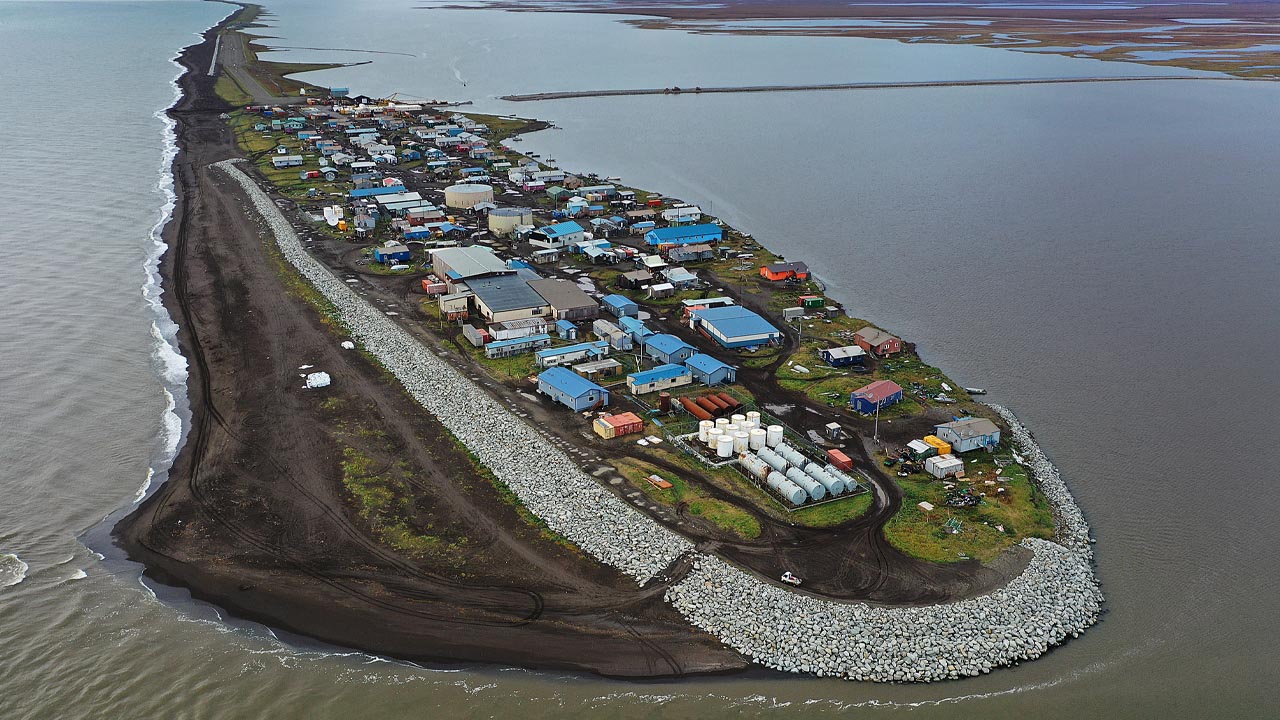
For generations, residents of a small, remote Alaskan village have built their lives on a narrow stretch of land surrounded by water. But today, the community is facing an increasingly frightening reality: the possibility that the ocean could eventually swallow their home, forcing hundreds of people to abandon the place they have called home for generations.
Situated on a narrow barrier island between Kivalina Lagoon and the Chukchi Sea, the village of Kivalina has spent years struggling against the devastating effects of coastal erosion. As the shoreline continues to disappear and sea levels rise, the future of the community has become increasingly uncertain. Residents have been warned that, sooner or later, they may have little choice but to leave their ancestral home behind and relocate somewhere safer.
As of 2020, approximately 400 people were believed to live in the village. At the time, agencies including the U.S. Army Corps of Engineers estimated that the island could reach a critical level of uninhabitability by 2025, potentially making it impossible for residents to continue living there safely.
That projected deadline has now passed, raising even more questions about what lies ahead for the isolated community.
The increasingly desperate situation in Kivalina was recently brought into focus by the YouTube channel Yes Theory, which sent Thomas and Stefan to spend three days in the village. During their visit, the two were able to experience everyday life on the island, speak directly with residents, and witness how the growing threat of losing their homes has affected the people who live there.
For those who have spent their entire lives in Kivalina, the possibility of leaving is about far more than finding somewhere else to live. It means potentially abandoning a community, a way of life, and a place deeply connected to their families and generations of history.
“They Just Washed Away”
Among the residents interviewed during the visit was Janet, who has lived in Kivalina her entire life. She described how coastal erosion gradually became a more serious threat, recalling the moment when the community first began realizing just how vulnerable its shoreline had become.
According to Janet, the situation started becoming noticeably worse in 1989, when residents began attempting to protect the banks using sandbags.
“1989 was the time when things started getting a little more intense with erosion. That was the first time they did sandbags, placing them by the banks. They just washed away, you know?” she explained, according to UNILAD. “And there was nothing they could do. And that’s when we realized that we have a problem.”
The failed attempt to protect the shoreline marked an important moment for the community. What had once seemed like a distant environmental concern was becoming an immediate threat to people’s homes and their future.
Janet also explained that authorities had already warned residents that relocating would eventually become unavoidable. The U.S. Army Corps of Engineers had given the village a projected deadline to move away from the vulnerable island.
“The Corps of Engineers gave us till 2025 to move out of here. They were pretty accurate. It’s 2026. Obviously, we got to move out of here,” she said.
However, not everyone in the community appears ready to accept the idea of leaving.
Janet’s brother, Reppi, expressed a different perspective, making it clear that he was not convinced relocating would be an easy or straightforward decision.
“Yeah, we’re staying… They’ll find out how much mosquitos is up there,” he said, referring to the higher ground where residents could potentially move.
His comment highlighted another challenge facing the community: finding a suitable place to rebuild their lives may not be as simple as moving away from the coastline.
Reppi also pointed out that the proposed area has its own environmental difficulties, particularly the condition of the land.
“It’s really marshy land up right where the school is,” he added.
His concerns reflect the complicated choices facing Kivalina’s residents. Even if moving becomes necessary, the alternative location must offer a safe and practical place for families to live, work, and raise their children.
Alaska Village Faces the Threat of Being Swallowed by the Ocean
For decades, Kivalina benefited from the protection provided by thick winter sea ice, which acted as a natural barrier between the village and the powerful waters of the Chukchi Sea.
During the colder months, the ice helped shield the coastline from the full force of ocean waves and storms. However, increasingly damaging storms have placed that natural protection under growing pressure, accelerating coastal erosion and causing substantial losses of land.
As the ice protection becomes less reliable, the village has become increasingly exposed to the destructive power of the ocean. Each major storm brings the possibility of further damage, putting homes, infrastructure, and the future of the community at risk.
The Yes Theory video illustrated just how quickly the coastline can disappear. During a particularly powerful storm in 2004, more than 12 meters of land were lost along certain sections of the village’s shoreline.
The damage did not stop there. Additional storms in the years that followed continued to threaten residential properties and essential infrastructure, making it increasingly difficult for residents to feel secure in the place they have always known as home.
Over time, protecting Kivalina has become a major challenge, requiring significant efforts to defend the island against further erosion.
A massive rock seawall has since been constructed to help protect the coastline from the force of the ocean. In addition, a new road and bridge, completed in 2020, established a connection between Kivalina and the Alaskan mainland, providing an important improvement to the village’s infrastructure.
These developments have helped make the community safer for the time being, offering residents some protection against the environmental threats surrounding them.
However, despite these improvements, the fundamental problem has not disappeared. The coastline remains vulnerable, storms continue to pose a serious threat, and the long-term future of the village is still uncertain.
For the approximately 400 people who call Kivalina home, the question is no longer simply how to protect their island from the next storm. It is whether they will eventually be able to remain in the place where generations of their families have lived, or whether the ocean will ultimately force them to leave everything behind.