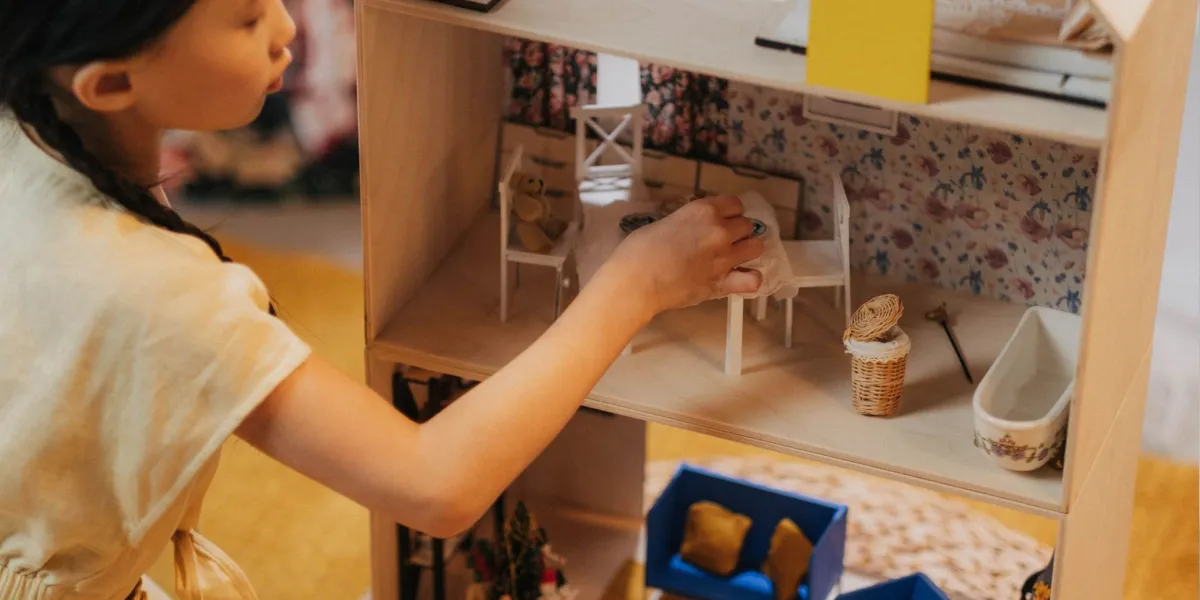
The dollhouse cost just $15. It leaned slightly to one side and smelled faintly of dust and rain. But to my granddaughter, Kelly, it was the most beautiful thing she had ever seen.
Then she discovered a hidden compartment beneath the roof. Inside were old letters written in my late daughter’s handwriting, along with a photograph of a boy I had never seen before.
When I read the first letter, I realized something was terribly wrong. I picked up my phone and dialed 911.
Kelly spent the first ten minutes apologizing to the dollhouse.
“I’m sorry your window fell out,” she whispered, touching the empty frame with one careful finger.
“I’m sorry somebody scratched your door.”
She examined the crooked attic roof before adding, “And I’m sorry your top is tired.”
The dollhouse stood nearly three feet tall. It had once been painted white, but years of grime had dulled its appearance. Faded yellow flowers decorated the wall beside the front door, one staircase sagged noticeably, and much of the wallpaper had begun peeling away.
It wasn’t perfect. Not even close.
But it was the only dollhouse I could afford.
For four months, I had been saving loose change in an empty coffee tin. I sold eggs from my hens, green beans from the garden, jars of homemade peach jam, and knitted baby blankets at the Saturday market. Every dollar I earned already had somewhere to go, and there was rarely anything left over.
Then my granddaughter saw a dollhouse in a toy catalog.
She pressed both hands against the page and stared at it as though she had discovered something magical.
“Do houses like this have families inside, Grandma?” she asked.
“Usually, baby.”
“Can I have one for my birthday?”
I looked at the price, then gently closed the catalog.
“We’ll see,” I told her.
I hated those two words. They were what I said when I wanted to give her something but couldn’t promise that I would be able to.
Three weeks later, I spotted an old Victorian dollhouse beneath a folding table at a church sale. A woman was selling it for $25.
I had only $15 in my purse.
I counted the money twice, hoping somehow I had missed a bill. The woman watched me quietly before finally saying, “Take it.”
I carried the dollhouse home on Kelly’s birthday.
The moment she saw it, she screamed with excitement. Her voice was so loud that the hens scattered from the porch.
She didn’t notice the missing window, the crooked staircase, or the faded paint. She saw a home waiting for someone to love it.
Now she sat cross-legged on the kitchen floor, arranging tiny wooden chairs around the miniature dining table. Some of the furniture had come with the house, and every piece looked as though it had been made by hand.
One chair had a crooked back. A little cradle rocked too far to one side. There was even a miniature desk with a drawer that opened only if you pulled it at just the right angle.
Kelly picked up a tiny wooden stool.
“Who made these?” she asked.
“I don’t know, sweetie.”
“Maybe a grandpa.”
“Maybe.”
Then we heard a small click.
Kelly froze.
“What was that? Grandma, the house made a sound.”
She pressed beneath the miniature fireplace mantel. Another click followed, and a narrow seam appeared along the attic roof.
Her eyes widened.
“Grandma, come look! The house has a secret.”
I sat down beside her. Together, we carefully lifted the roof.
A hidden compartment opened beneath it.
Inside lay a faded photograph and a bundle of old letters tied together with a blue ribbon.
Kelly reached for the photograph first.
It showed a teenage boy standing beside the very same dollhouse, one hand resting on its roof. He had dark hair, serious eyes, and a smile that seemed to arrive a little late.
Kelly studied his face.
“Grandma, is this my twin?”
I laughed because the question seemed impossible. Then I took the photograph from her.
But the moment I looked more closely, my smile disappeared.
The boy’s eyes were exactly like Kelly’s. So was his narrow chin.
I turned the photograph over.